A digital platform facilitates the deployment of green hydrogen in Europe
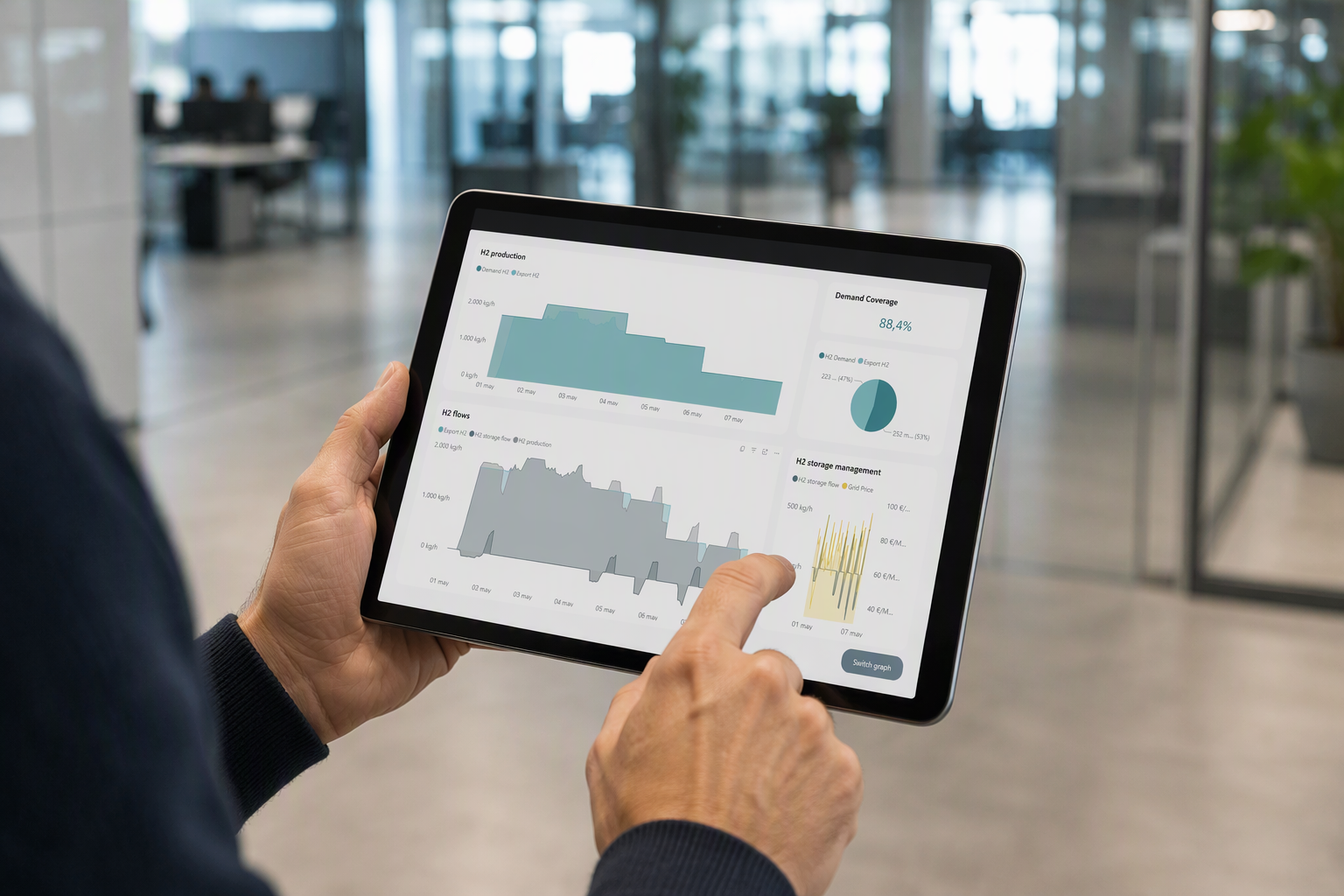
Grupo Sener leads the development of SenHy, a tool that maximizes the profitability of power plants, developed with the collaboration of the Tekniker technology centre in specific capabilities.
To meet the challenges of the energy transition, the industry is demanding new solutions capable of minimizing investment risk. In this context, the engineering and technology Grupo Sener has successfully completed the development of SenHy, an advanced digital platform designed for the simulation and optimization of green hydrogen generation plants. For this, it has had the collaboration of the technology centre Tekniker, a member of the Basque Research and Technology Alliance (BRTA).
The new tool aims to define the most efficient design configurations and the best operating strategies, ensuring maximum profitability and viability of the facilities in the face of the complexity posed by the integration of variable renewable energies.
The development of this digital tool is part of the Important Project of Common European Interest (IPCEI), an initiative that seeks to act as a key accelerator for the energy transition and contribute to the industrial decarbonization objectives of the European Union.
From an economic point of view, SenHy directly impacts the financial viability of new developments by focusing on comprehensive cost reduction: it minimizes initial investment, optimizes operating expenses, and, most notably, reduces the levelized cost of hydrogen production. All this allows optimizing the business models of the plants and maximizing their profitability, while at the same time facilitating the large-scale deployment of this clean energy by reducing the risk associated with investments.
“SenHy combines Sener´s industrial and engineering experience with Tekniker´s applied research and advanced modeling capabilities, resulting in a solution oriented toward real industrial applications and scalable for both pilot plants and large facilities,” highlights Mikel Armendia, researcher at Tekniker.
“At Sener we develop engineering solutions to respond to the challenges posed by the energy transition. In the field of hydrogen, this means integration of renewables, different electrolysis technologies and different operating scenarios, all within a context of technical and economic complexity that directly impacts project viability. In this context, SenHy fits, an initiative in collaboration with Tekniker to develop an advanced platform for the design, simulation and operation of hydrogen plants,” says Marc Herrera, Director of Corporate Innovation at Sener.
Challenges to enhance current tools
SenHy addresses the limitations of current market tools and emerges as a digital twin that allows multiple scenarios to be evaluated with unprecedented detail, reaching the point of simultaneously simulating more than 200 interrelated parameters.
One of the main advantages of the platform is its flexibility. The system allows the integration and combination of different electrolysis technologies, such as PEM (Proton Exchange Membrane) and alkaline, within the same hybrid plant. This capability, developed thanks to the joint work of Sener and Tekniker, overcomes the limitations of current market alternatives, which are usually specialized in a single technology.
Based on Sener´s experience in developing digital solutions for the energy sector, SenHy incorporates a multiphysics optimization algorithm capable of evaluating multiple operating scenarios and optimizing key indicators such as production cost, investment, and operation strategy. This capability is complemented by an advanced Power Management System (PMS) developed by Tekniker, which dispatches production orders automatically and adapts operation to the availability of renewable energy at each moment. Sener has worked on integrating both capabilities into a single platform, allowing optimization of both the installation design and its operation in real time.
“The main added value lies in its ability to combine advanced simulation, detailed physical modeling, and techno-economic optimization within the same platform,” adds Mikel Armendia.