A failed experiment leads to a chemical discovery that could revolutionise drug manufacturing
CIC energiGUNE researcher Prof. Max García-Melchor contributes to the development of a new light-driven chemical reaction that enables drugs to be modified more efficiently and sustainably
A failed laboratory experiment has led to an unexpected discovery that could change the way medicines are designed and manufactured. An international team of researchers, including Prof. Max García-Melchor, head of the Atomic and Molecular Modelling for Catalysis group at CIC energiGUNE and Ikerbasque Research Professor, has contributed to the development of a new light-driven chemical reaction that enables complex drug molecules to be modified more efficiently and sustainably.
The work, published in Nature Synthesis, describes a reaction the team calls “anti-Friedel–Crafts”, a new way of creating carbon–carbon bonds — one of the fundamental processes of organic chemistry — under mild conditions and without the need for precious metal catalysts or toxic reagents.
The research was led by the University of Cambridge, with the participation of researchers from Trinity College Dublin, CIC energiGUNE and the pharmaceutical company AstraZeneca.
In traditional chemistry, Friedel–Crafts-type reactions use strong chemicals or metal catalysts under harsh experimental conditions. As a result, these reactions can normally only be used in the early stages of drug synthesis, subsequently requiring numerous additional chemical steps to reconstruct the final molecule.
The new approach developed by the international team reverses this pattern, allowing drug molecules to be modified in the final stages of their development.
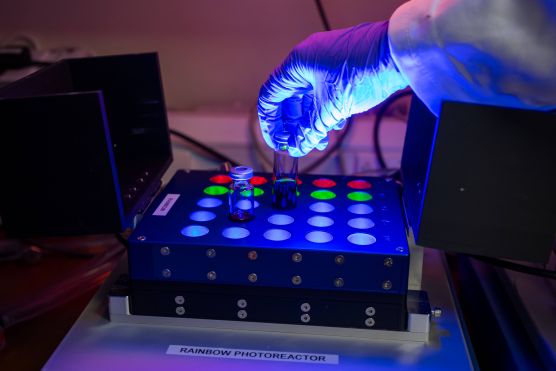
Instead of using heavy-metal catalysts, the reaction is triggered by light from an LED lamp at room temperature. Once activated, it triggers a self-sustaining chain reaction that allows new carbon–carbon bonds to form under mild conditions and without the need for toxic or expensive chemicals.
In practical terms, this means that chemists can introduce specific modifications to complex molecules without having to dismantle and rebuild them from scratch, a process that in many cases can take months.
The reaction is highly selective, allowing a specific part of a molecule to be modified without affecting other sensitive regions – a property chemists refer to as high functional group tolerance. This characteristic is particularly important in drug development, where even small structural changes can significantly influence a drug’s efficacy, its behaviour within the body, or potential side effects.
By reducing the number of steps required in chemical synthesis, the method could also lower energy consumption, reduce toxic chemical waste and speed up the development of new medicines.
The study combines chemical experimentation with advanced theoretical modelling and artificial intelligence tools to understand the reaction mechanism and predict where it is likely to occur in complex molecules, helping to guide future experiments and accelerate the exploration of new drug candidates.
These theoretical contributions have been led by Prof. Max García-Melchor and his team at CIC energiGUNE, in close collaboration with Trinity College Dublin.
“Understanding why this reaction works and predicting where it might occur in complex molecules has required combining experimental chemistry with advanced computational modelling,” explains Prof. Max García-Melchor. “Our work helps to reveal the mechanism of this transformation and demonstrates how theory and machine learning can guide the discovery and development of new chemical reactions.”
A discovery arising from a control experiment
The breakthrough emerged unexpectedly during a control experiment. The researchers were testing a photocatalyst when they removed it as part of the test and found that the reaction worked just as well — and perhaps even better — without it.
What initially appeared to be an experimental error ended up revealing a new chemical mechanism. Throughout the history of science, some of the most important discoveries — from penicillin to X-rays — have also arisen from unexpected observations.
In this case, what appeared to be a failed experiment revealed a new chemical tool with the potential to transform the way medicines are designed and manufactured, with significant implications for a pharmaceutical industry seeking increasingly efficient and sustainable processes.