BCBL, the University of Cambridge and CNRS collaborate to use AI to detect language disorders before school age
Basque is one of the four languages being studied in a project funded by the European Research Council with €2.5 million.
The study, led by British researcher Usha Goswami, will analyse the speech of more than 1,000 children aged between 2 and 8 in Basque, Spanish, French and English.
The laboratories at the Basque centre will play a key role in data collection: around 400 children will undergo testing at the BCBL.
Identifying dyslexia or Developmental Language Disorder (DLD) before a child learns to read or even before they start school is currently a major challenge for speech therapy and neuroscience.
A new international project, led by the prestigious researcher Usha Goswami from the University of Cambridge, seeks to revolutionise this field with the strategic collaboration of the Basque research centre Basque Centre on Cognition, Brain and Language (BCBL).
The initiative is funded by the European Research Council through a €2.5 million ERC Advanced Grant awarded to Dr Goswami.
The study will analyse and compare more than 1,000 children aged between 2 and 8 from Spain, France and the United Kingdom who speak four languages with very different rhythms: Basque, Spanish, French and English. The aim is to test whether rhythmic difficulties are universal, regardless of the language being learned.
To understand her objectives, Dr Goswami invites us to imagine that speech is ‘like an orchestra’: ‘For a word to sound right, not only do the instruments (the sounds) have to be right, but the rhythm and intensity (the metre) have to be precise’.
In previous studies conducted in English, Dr Goswami discovered that children with dyslexia have problems perceiving characteristics of syllable synchronisation (as if a musician were playing some notes out of rhythm), while children with SLI have difficulties with both speech rhythm and intonation or “melody” (the tone of voice).
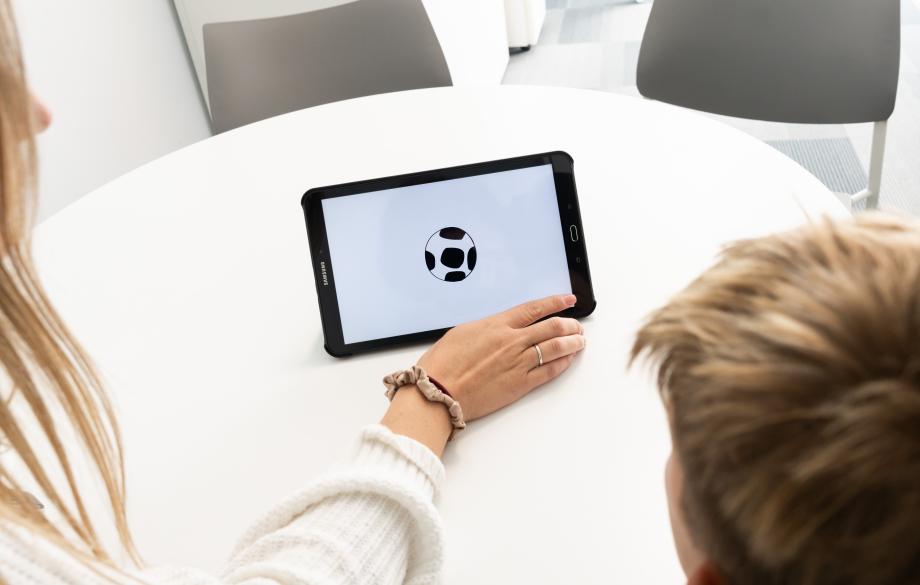
The research consists of a simple and playful task: children see an image on the computer (such as the character Aladdin or a dinosaur), hear the word and repeat it. A system records their voice and, using specialised voice analysis software and artificial intelligence (AI), evaluates the accuracy of oral repetition and rhythmic patterns to detect invisible signals in their speech that help predict future disorders.
‘Our main challenge is early identification, which allows us to offer support much earlier. By starting our project at age 2, we hope to identify subtle differences in speech production that signal who might be at risk long before school age,’ explains Usha Goswami.
The BCBL’s contribution
The San Sebastian centre will lead a fundamental part of the research. Researchers Marie Lallier and Marina Kalashnikova will coordinate the testing of nearly 400 children in the Basque Country, using the BCBL’s laboratories and the centre’s speech therapy clinic, NeureClinic.
‘If we find similar data in the four languages, this would suggest an intrinsic difficulty in the perception and production of speech rhythm in children with language disorders,’ says Marie Lallier.
This would open the door to new rhythm-based therapies, such as clapping along to the strong and weak syllables of words before starting to read.
‘Currently, it is extremely difficult to predict which children will develop a disorder; for example, half of children who do not say a single word by the age of 2 do not end up with a language disorder,’ adds Marina Kalashnikova.
This project aims to create a simple diagnostic tool for clinicians: an AI-powered word repetition test that detects risk almost instantly.