Satlantis is strengthening its leadership in the space sector with the launch of ‘Unamuno’, its most advanced microsatellite
The Basque company, based at the Leioa Campus of the Basque Country Technology Park, has launched a new system capable of providing near-real-time Earth observation, furthering its technological and economic growth
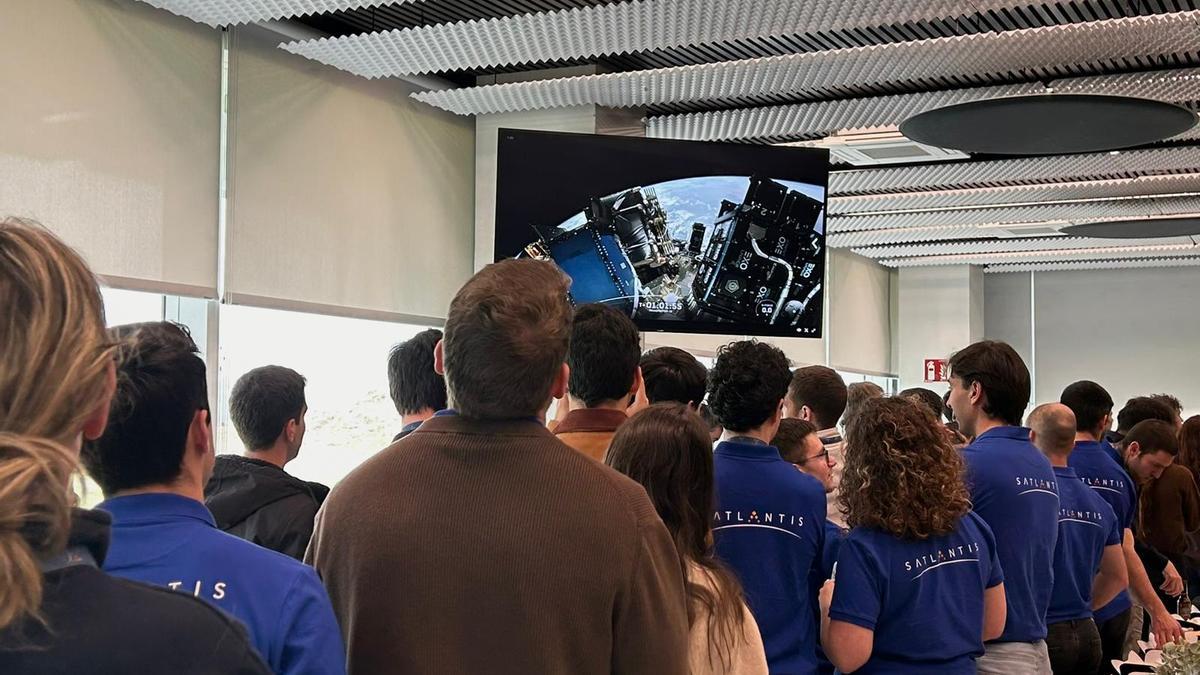
Satlantis has launched its fifth microsatellite, named Innosat Unamuno, marking a new milestone in its Earth observation programme. The device, named in honour of the writer and thinker Miguel de Unamuno, was launched on Monday from Vandenberg Space Force Base at 13:02.
The satellite was launched aboard a Falcon 9 rocket, operated by SpaceX, as part of the Transporter-16 shared mission, alongside 118 other payloads. It is currently in a sun-synchronous orbit at an altitude of between 500 and 550 kilometres.
New generation of technology
The satellite —also known as Garai B— is part of the company’s new generation of microsatellites weighing approximately 100 kilograms. It is designed for bespoke applications, incorporating advanced capabilities such as high-resolution multispectral observation, video capture, SWIR technology and polarimetric analysis.
To this end, it incorporates two proprietary cameras, the iSIM-90 and iSIM-170, capable of operating in the visible, near-infrared (NIR) and SWIR spectra. Furthermore, it introduces a polarimetry channel that significantly expands the possibilities for analysing the Earth’s surface. The project has been developed in collaboration with OHB Sweden.
Near-real-time data
As the company’s CEO, Juan Tomás Hernani, explained, this new system can cover up to 400 kilometres in just one minute, compared to traditional methods that require multiple passes over a period of weeks. This improvement in speed and accuracy enables access to near-real-time data, with key applications in fields such as security, defence and advanced land monitoring.
With this launch, the company is expanding a constellation that already includes satellites such as URDANETA-ARMSAT1, GEISAT P., HORACIO and GARAI A, consolidating its commitment to high-tech observation systems.
Expansion and growth prospects
The deployment of Garai B strengthens the company’s international position in the microsatellite segment and responds to a growing demand for rapid, operational solutions within the aerospace sector. In this context, the company has a portfolio of more than 24 cameras due to be delivered over the next twelve months.
To cope with this increase in activity, the company has recently expanded its production facilities with an additional 1,000 square metres of cleanrooms and new laboratory space.
Financially, the company’s performance shows a marked acceleration. In 2025, it achieved a turnover of €47.8 million, representing an 80% increase on the previous year. Earnings before interest, taxes, depreciation and amortisation (EBITDA) stood at €14.4 million, whilst operating cash flow exceeded €16 million, with a cash position of over €46 million at the end of the financial year, enabling the company to face the medium term without the need for additional financing.
Looking ahead, the company expects to exceed €70 million in revenue in 2026 and surpass €100 million in 2027. It currently employs over 220 professionals based at its headquarters on the Leioa Campus of the Basque Technology Park, as well as in Cambridge (UK), Gainesville (Florida) and France.