A new generation of collaborative robots set to transform industrialised construction
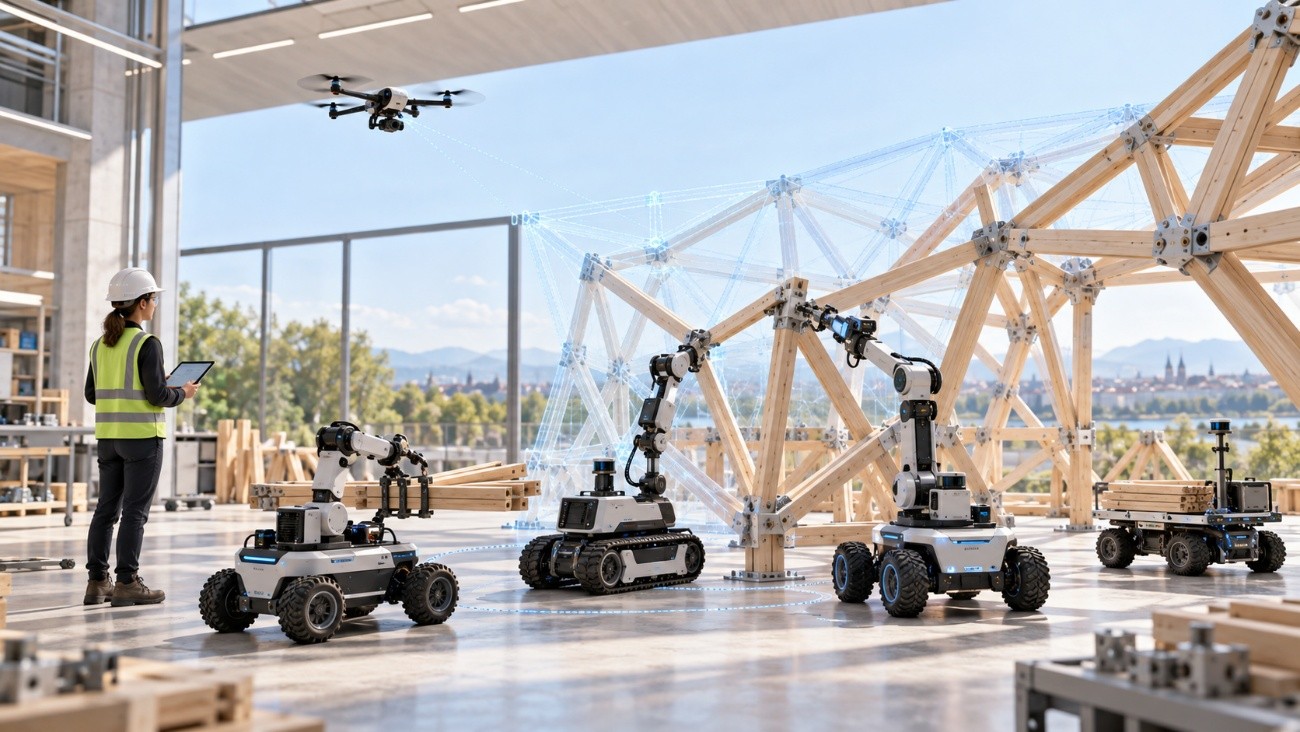
TECNALIA leads SITEBOT, an initiative that will develop swarms of robots capable of working together to automate the construction of safer and more efficient modular structures
The construction industry faces major challenges related to productivity, occupational safety, the shortage of skilled labour and the need to move towards more sustainable, efficient and circular models. To address these challenges, TECNALIA is coordinating the SITEBOT initiative, a project that will develop pioneering technologies based on swarms of autonomous robots capable of collaborating with one another to carry out complex construction tasks under human supervision.
The aim is to lay the foundations for a new generation of construction systems in which ground-based and aerial robots work in coordination to transport, handle and assemble industrialised construction components.
Unlike conventional robotic systems, which rely on individual machines designed to perform specific functions, SITEBOT will adopt an approach inspired by collective behaviour. Different specialised robots will be able to combine their capabilities and dynamically reorganise themselves to tackle more complex tasks, adapting to changing conditions on construction sites.
This new paradigm will enable the European consortium to create flexible robotic teams capable of collaborating with one another, sharing information about their surroundings and responding to incidents or changes in real time, thereby increasing the efficiency and autonomy of construction processes.
The technology developed will incorporate advances in artificial intelligence, environmental perception, autonomous navigation, robot-to-robot communication and human-machine collaboration, enabling multiple units to operate as a single coordinated system.
Sustainable and automated construction
One of the project’s distinguishing features will be the joint development of both robotics technologies and the construction systems themselves.
SITEBOT will research lightweight modular components and reversible joining systems specifically designed to facilitate robotic assembly. This approach will optimise the interaction between digital design, industrialised manufacturing and automated construction. In addition, the solutions developed will incorporate circular economy principles, making it easier to dismantle, reuse and adapt construction components in the future, while reducing resource consumption and waste generation.
Human participation will remain a fundamental part of the system. The project will develop tools to enable operators to supervise activities, understand the status of the robots and interact with them intuitively, ensuring that people retain control over the processes.
The project will also include laboratory validation of a demonstrator featuring a modular construction assembled by a coordinated group of robots. This demonstrator will make it possible to assess the feasibility of the technology in representative scenarios and lay the foundations for future industrial applications capable of accelerating the sector’s transition towards more automated, resilient and sustainable construction models.
SITEBOT is part of the EIC Pathfinder programme under Horizon Europe and will bring together TECNALIA, the Spanish company ROVIMATICA, OTH Regensburg University of Applied Sciences (Germany) and École Nationale des Ponts et Chaussées (France) over the next four years.