BC3 addresses the challenges of climate resilience in the EU from a scientific perspective alongside European representatives and the Basque Government
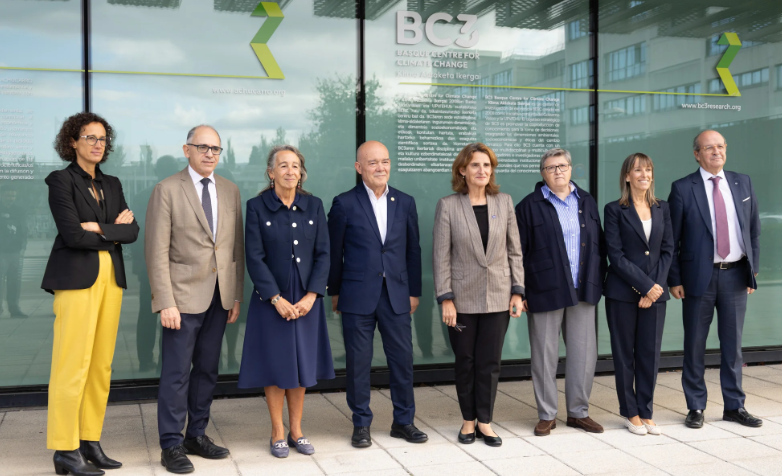
Teresa Ribera, Executive Vice-President of the European Commission, and Juan Ignacio Pérez Iglesias, Regional Minister for Science, Universities and Innovation of the Basque Government, have visited BC3, the Basque Government’s centre of excellence for climate change research
María José Sanz, Scientific Director of BC3, shared with European Commission visitors contributions from European Adaptation Mission projects relevant to the European Climate Resilience Framework
The climate change research centre Basque Centre for Climate Change (BC3) received a visit from Teresa Ribera, Executive Vice-President of the European Commission and Commissioner for a Clean, Just and Competitive Transition, and Juan Ignacio Pérez Iglesias, Regional Minister for Science, Universities and Innovation of the Basque Government, the institution to which the centre is attached.
During the meeting, BC3 Scientific Director María José Sanz introduced the centre, and topics related to the European Climate Resilience Framework, key for future transformations in Europe, were discussed.
The Integrated European Climate Resilience Framework, scheduled for adoption in the fourth quarter of 2026, aims to identify the EU’s most vulnerable territories to prioritize investments, reinforce response capacity to extreme weather events through tools such as the rescEU system, adapt public and private disaster insurance schemes, and deploy specific plans against extreme temperatures, among other measures.
In this context, the Vice-President stressed that: “Europe cannot afford to continue spending more on repairing climate change damage than on preventing it. Nor can we allow the most vulnerable to pay the bill for a lack of preparedness. We need to anticipate risks, be aware of their costs, and find new ways to finance adaptation fairly. Collaboration between public administrations, insurers, and the private sector can significantly help in this effort. Science is fundamental to achieving this. Centres of excellence like BC3 help us transform knowledge into concrete solutions. That is the ambition of the new European Climate Resilience Framework: to mobilize investments to protect people, our economies, and our territories. Because investing in resilience today means avoiding much greater damage and losses tomorrow,” highlighted Ribera.
Likewise, the Basque Government Minister highlighted BC3’s trajectory as an international benchmark centre for climate change research and expressed his satisfaction that the Basque Country possesses a facility with these capabilities.
Pérez Iglesias noted that climate change is a major concern for society and a priority for the Basque Government, which is designing measures within its scope of competence to “contribute to adapting to its effects in a socially just manner.”
He also referred to the strategic lines linked to the energy-climate transition included in the Basque Science, Technology and Innovation Plan 2030: Decarbonisation, One Health, and Sustainable and Healthy Food. Added to these, due to their instrumental nature, are Artificial Intelligence and Quantum Sciences and Technologies.
During the meeting, results from several European projects led by BC3 were shared. This research puts into practice and addresses key elements framed within the European Resilience Framework, including the identification, assessment, and distribution of risks to build shared resilience; the necessary financing mechanisms and enabling policies for effective and joint adaptation; the importance of dialogue and participation in these processes; and considering adaptation and mitigation as a unified investment case.
All of this is supported by tools and a data processing approach based on interoperability and accessibility via BC3’s ARIES platform, an open-source solution that utilizes semantic interoperability and AI to integrate data and models from different disciplines seamlessly to address a complex climate reality.
“A resilient transformation in the territory means moving from isolated measures to an adapted pathway suited to a specific context: a region or municipality integrated into a broader framework and the key community systems supporting them, from critical infrastructure to ecosystems. The EU European Climate Resilience Framework should outline the transition, not just the end state,” concluded María José Sanz.