TECNALIA and AZTI, members of BRTA, seal a long-term strategic alliance in agri-food and the blue economy
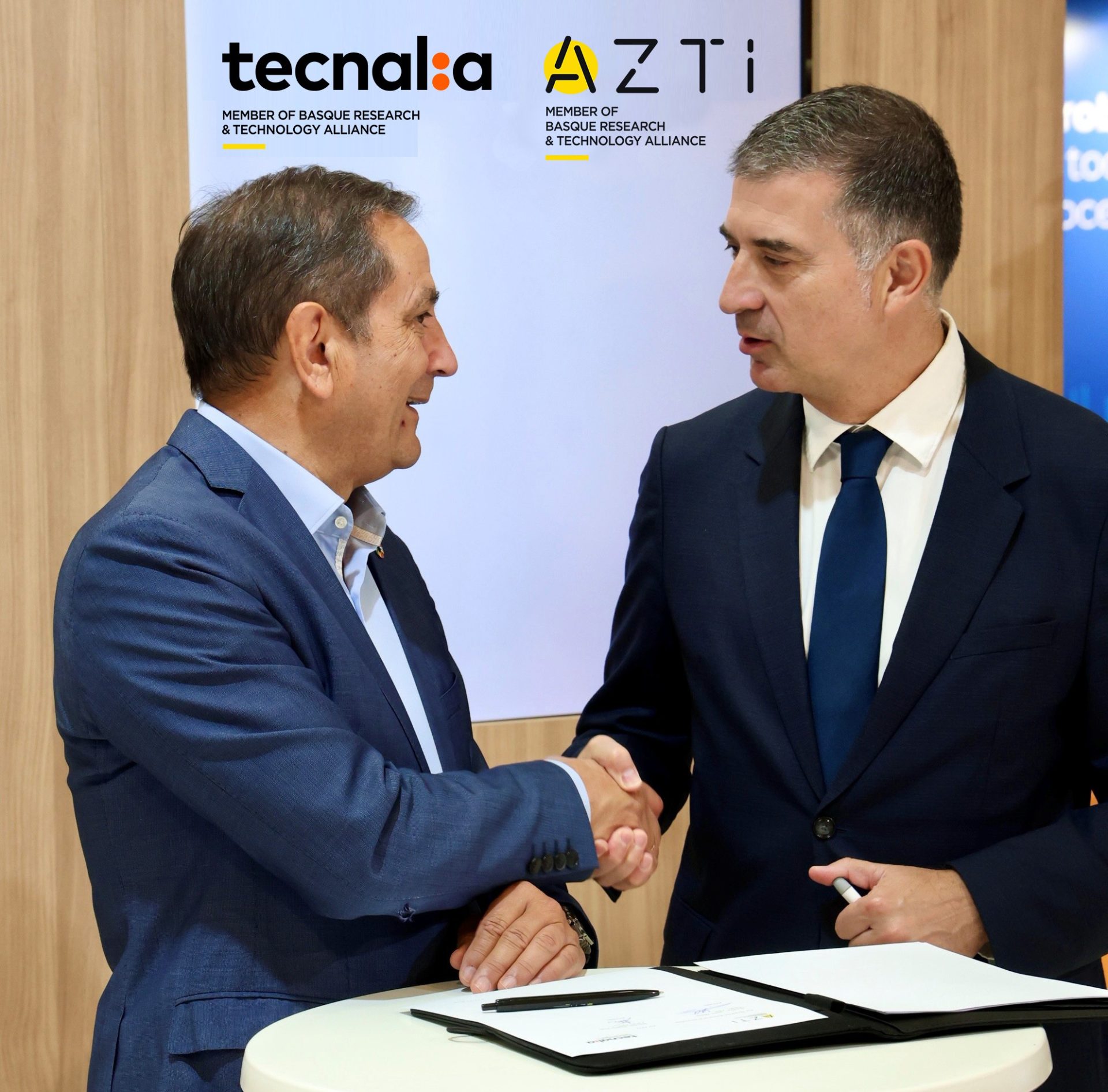
The agreement — framed within AZTI’s Strategic Project — integrates industrial digitalisation, AI, sensors and biotechnology (TECNALIA) with sustainable food systems, blue food and bioeconomy (AZTI), and envisions, as a long-term goal, the creation of a joint business unit oriented towards technology transfer.
TECNALIA and AZTI — both members of the Basque Research & Technology Alliance (BRTA) — have signed a long-term strategic alliance to jointly address the challenges of the agri-food industry and the blue economy. The agreement integrates complementary capabilities in digitalisation, AI and biotechnology (TECNALIA) with sustainable food systems, blue food and bioeconomy (AZTI), and foresees, as a horizon, the establishment of a joint business unit to accelerate market transfer.
The alliance is part of the ALIANZAS Strategic Project, one of the pillars of the 2026 Management Plan and AZTI2030, as well as the Strategic Plans of TECNALIA and AZTI, and is aligned with the objectives of the Basque Gastronomy and Food Strategic Plan 2030 (PEGA2030) in technological innovation, international expansion and business cooperation.
TECNALIA’s General Director, Jesús Valero, and AZTI’s General Director, Rogelio Pozo, signed the agreement at the Food4Future Fair, committing to optimise scientific capabilities and technological resources in a shared platform for the entire food and marine value chain, with tangible benefits for companies, consumers, society and the natural environment.
“This alliance is not a one-off agreement: it is a new way of working,” explained Rogelio Pozo, General Director of AZTI. “Forming alliances does not dilute our identity, it defines it more clearly. We add TECNALIA’s digital and industrial biotechnology capabilities to our track record in marine and food science to offer companies more complete proposals, larger teams and shorter response times. The horizon of creating a joint business unit is the best guarantee that this alliance will reach the market.”
“The alliance seeks to act as a tool for competitiveness for industry, enabling the acceleration of innovation processes, reducing technological development times and improving responsiveness in an increasingly demanding and changing context,” stated Jesús Valero, General Director of TECNALIA.
A more complete proposal for the agri-food industry
The combination of TECNALIA and AZTI’s multidisciplinary teams will enable the provision of integrated solutions to companies in the agri-food sector and its value chain (ingredients, packaging, auxiliary goods and services), combining processing and preservation technologies, healthy ingredients, digitalisation of quality control and consumer perception.
Digital twin, AI and sensing for the sea and food
TECNALIA and AZTI will work together on the development of advanced digital solutions — including digital twins, applied AI and sensing — for the monitoring and sustainable management of aquatic ecosystems, improving energy efficiency, reducing waste in the marine value chain, and developing intelligent systems for more precise and sustainable management of natural resources.
Blue biotechnology and valorisation of marine resources
The agreement promotes initiatives in the blue economy such as the valorisation of marine by-products and blue biotechnology, an emerging discipline focused on bioprocesses, advanced fermentation and new functional foods of marine origin, with applications in food, health and sustainability.
Governance, time horizon and open model
The alliance is structured through a Joint Steering Committee meeting quarterly, an operational coordination body and a high-level Commission with representation from the governing boards of both organisations, meeting annually. A mid-term review of the agreement’s progress is planned after 18 months. The MoU includes explicit non-competition agreements within the scope and markets of the alliance, as well as a deliberately open model allowing the incorporation of other complementary partners. As initial visible milestones in 2026, the two organisations are already working on joint proposals for competitive European calls, coordinated presence in sector forums and a shared technology mapping exercise.