The Basque Country’s science industry provides cutting-edge technology for research with neutrons
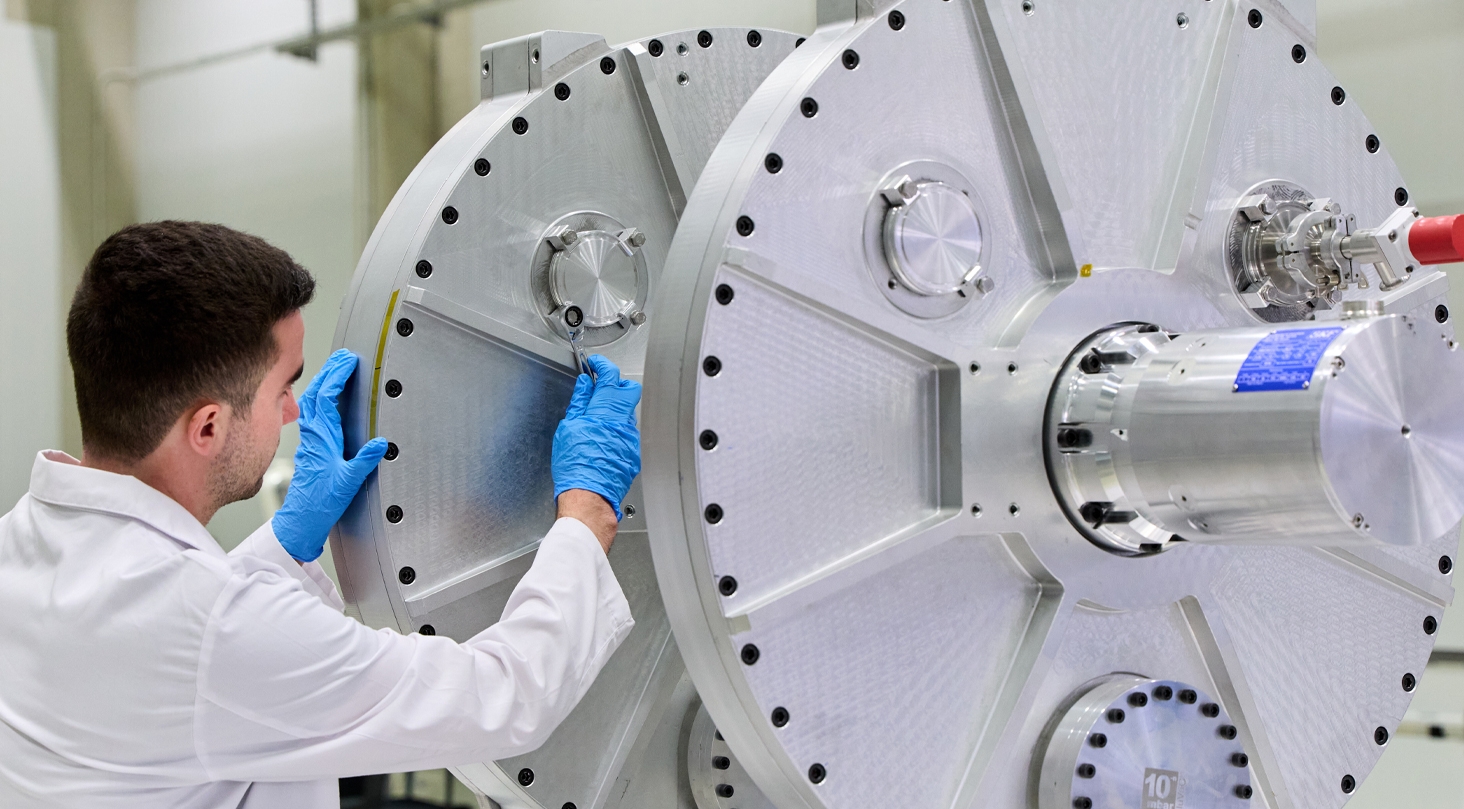
The Tekniker technology centre has manufactured, fine-tuned and validated an advanced mechanical system for one of the key instruments of the European Spallation Source (ESS).
Neutronics is nowadays one of the main areas of research with potential applications in medicine, energy and climate change. The European Spallation Source (ESS) offers an example of recent advances made in this scientific domain. The infrastructure is currently being built in Lund (Sweden) and will be equipped with the world’s most powerful neutron source.
The technology supporting these facilities is being developed in several European nations, including the Basque Country. The Tekniker technology centre, a member of the Basque Research and Technology Alliance (BRTA), has an extensive amount of experience in supporting the development of the science industry via in-house R&D and is actively involved in the fine-tuning of the ESS.
Tekniker, together with Aernnova Engineering and ESS Bilbao, a strategic centre for neutronic technologies set up to produce knowledge and added value through contributions focused on the European Spallation Source (ESS) in Sweden, has been involved in the development, fine-tuning and validation of an advanced mechanical system for the choppers on the MIRACLES instrument, one of the key scientific ESS elements.
In this project, Tekniker’s experience and technological knowledge have significantly boosted the work jointly carried out by Aernnova and ESS Bilbao aimed at reinforcing the development of a high accuracy solution for cutting-edge neutronic instrumentation. The 162,5 metre-long MIRACLES instrument will make it possible to study dynamic processes within an extensive range of energy settings and open up new research possibilities in areas such as life sciences, polymer sciences, energy materials and magnetism studies.
High temporal and energy resolution
The system manufactured by the technology centre does not only provide extremely high precision modulation for the neutron beam on the instrument but also generates time windows that make it possible to select energy by using flight time techniques.
Andoni Delgado, the person in charge of the Science Industry unit at Tekniker, explains that “scientific experiments for the ESS facilities require a very high degree of temporal and energy resolution which means that advanced mechanical systems that can operate at high speeds with high levels of stability and synchronisation must be used. As there are no standard commercial solutions meeting all of these requirements under such demanding conditions, we have developed a specific system adapted to this environment”.
The system’s main added value is its ability to offer an extremely high level of temporal accuracy and an exact synchronisation with a pulsed neutron source in addition to the possibility of operating at high rotational speeds whilst maintaining dynamic stability and reliability under demanding conditions.
Unlike other more generic and commercial solutions, this is a highly specialised development specifically designed for ESS that brings together the scientific knowledge of ESS Bilbao, the industrial experience of Aernnova and the advanced research capabilities of Tekniker, also involved in the final installation work of the equipment to ensure it’s correctly incorporated to the operating environment.