Industrial knowledge transfer drives Tekniker to a record €35.2 million in revenue
The technology centre increased its revenue by 5% in 2025 compared to the previous year, thanks to a balance between privately and publicly funded projects
The technology centre Tekniker, a member of the Basque Research and Technology Alliance (BRTA), continued in 2025 to consolidate its position as a benchmark organisation in technology transfer to the business sector, closing the year with a new revenue record of €35.2 million. This result represents a 5% increase compared to the previous year and validates the first year of implementation of the 2025–2028 Strategic Plan.
The centre’s financial performance is underpinned by a balance between privately and publicly funded projects. Of total revenue, 49% came from R&D activities directly contracted by companies. Throughout 2025, the technology centre carried out a total of 207 industrial projects with 191 organisations. In addition, it maintains a stable collaboration framework with 30 organisations, half of which are Basque SMEs, demonstrating its commitment to the local industrial fabric.
The remaining 51% of revenue originated from various sources of public funding: 25% from programmes of the Basque Government, 18% from European Union projects, 7% from the Spanish central administration, and the remaining 1% from the Provincial Council of Gipuzkoa.
In line with the priorities of the Basque Government’s Industrial Plan, more than 95% of Tekniker’s technological and scientific activity was focused on the biosciences, aerospace, advanced manufacturing, renewable fuels, energy storage and automotive sectors.
These fields are complemented by the Science Industry, a distinctive area of specialisation of the centre aimed at supporting local companies in accessing major international tenders. For example, Tekniker actively participates in fusion-related projects such as IFMIF-DONES and ITER, in the development of particle accelerators for radiotherapy, and in the space sector. This track record has also driven an increase in the acquisition of industrial projects beyond public programmes, with notable contracts such as METROTOWER and MUVACAS.
Talent, advanced infrastructure and sustainability
To support this level of activity, the centre’s workforce grew by 5.6% in 2025 to reach 320 employees, consolidating a scientific base of 80 PhDs and 24 doctoral candidates. This high level of specialisation enables the transformation of technical knowledge into valuable industrial assets, a capability that during the year resulted in the creation of seven new intellectual property families in the form of patents or registrations.
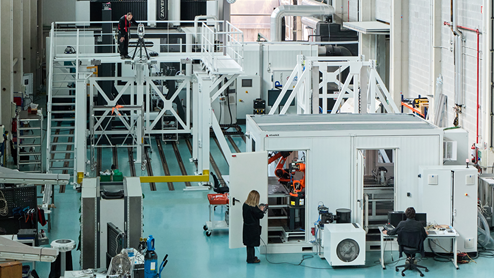
Tekniker also invested €2.3 million to enhance its facilities and technological equipment. Specifically, these investments have strengthened the capabilities of its laboratory for testing materials under extreme conditions and prepared its infrastructure to advance research in quantum and photonic technologies.
Noteworthy are also the joint laboratories located at its facilities alongside multinationals such as SCHUNK and ZEISS, including the inauguration of the ZEISS Quality Excellence Center, as well as the collaboration with the Italian company GES to establish its team for the development of robust and sustainable storage technologies at Tekniker’s facilities. In this same line of partnerships aimed at the energy transition and circular economy, the centre actively participates, together with the technology centre CEIT, in the BATTIA business initiative, focused on the industrial development and validation of electric vehicle battery recycling technologies.
This sustainable impact on the market is coordinated with the centre’s internal environmental management, which has registered its 2024 carbon footprint in the official registry of the Ministry for the Ecological Transition and the Demographic Challenge (MITECO). The attainment of this reduction label, under Royal Decree 214/2025, recognises the continuous reduction of its greenhouse gas emissions through energy efficiency plans, infrastructure optimisation and the promotion of sustainable mobility.