Basque Government and BCBL present BRAINORIUM, an applied research project to better understand how pupils learn
Around 400 children have already participated in research promoted by BCBL on language, reading, and cognition, developed through neuroscience techniques and methodologies applied to learning.
The initiative is being carried out at the Amara Berri public school, in collaboration with the Basque Government, and aims to generate useful knowledge to improve reading comprehension, anticipate potential difficulties linked to language and reading, and better adapt the educational response to pupils.
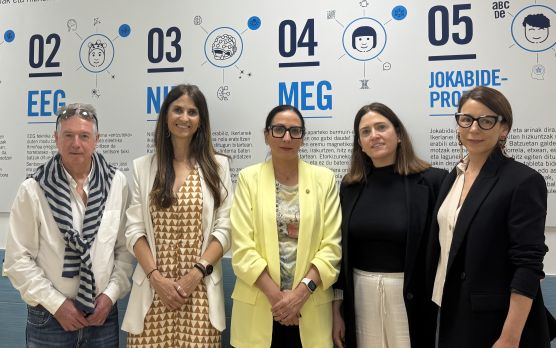
The Basque Government and the Basque Centre on Cognition, Brain and Language (BCBL) have presented the Brainorium project at the Amara Berri school in Donostia. This applied research initiative is promoted by BCBL in collaboration with the Basque education system to better understand how language, reading, and learning develop during childhood. The presentation was attended by the Regional Minister for Education, Begoña Pedrosa; the Deputy Scientific Director of BCBL, Lucía Amoruso; the Deputy Headteacher of Amara Berri, Idoia Alonso; and Maialen Agirre, Director of Innovation at the Basque Government’s Deputy Ministry for Science and Innovation.
The project takes place within the Amara Berri school itself, which serves as a reference environment for various applied research studies conducted by BCBL related to oral language, reading, multilingualism, and different cognitive processes linked to learning.
Since its launch approximately one year ago, around 400 children have already participated in various studies carried out under the framework of Brainorium. These projects will continue to develop over the coming school years through new research aimed at better understanding how children learn and how this process is influenced by factors such as language, reading, auditory processing, or multilingualism.
Research applied to learning and multilingualism
The various projects undertaken within Brainorium combine research in language, reading, multilingualism, cognition, and the neuroscience of learning to better understand how linguistic and reading skills develop in childhood.
The Deputy Scientific Director of BCBL, Lucía Amoruso, highlighted that “one of the unique features of Brainorium is precisely that the research is carried out within a school, in contact with the daily reality of learning.” As she explained, “this allows us to study how children actually learn in their usual environment and generate more useful knowledge for the educational field.”
Amoruso also noted that “many of the questions we are investigating stem from real situations that arise in classrooms,” and stressed that the goal of Brainorium is to “better understand processes related to language, reading, or multilingualism in order to develop increasingly tailored educational tools and strategies in the future.”
The research analyses issues related to auditory processing, language learning, oral language development, and brain function linked to reading and learning. Some of the studies explore, for instance, how basic auditory skills like distinguishing sounds or recognising melodic patterns can influence the learning and pronunciation of a second language.
Other projects analyse how multilingualism and literacy influence brain organisation and function, especially in a context like the Basque Country, where many children grow up using different languages from an early age.