TECNALIA leads the development of a pioneering non-invasive neuromodulation prototype for conditions such as stroke and Parkinson’s disease
The applied research and technological development centre has led the creation of a system that guides and transports nanoparticles across the blood–brain barrier and uses them to modulate the activity of target neurons with millimetric precision.
This is a pioneering development made possible through collaboration with Achucarro, DIPC, CFM, FBB, CUN, Bitbrain and the University of the Basque Country (UPV/EHU).
The applied research and technological development centre TECNALIA has led the development and validation of an innovative prototype focused on ultra-precise neuronal stimulation through the excitation of selective nanoparticles using light and magnetic fields from outside the body — in other words, in a non-invasive manner — opening up a new pathway for treating neurological diseases such as stroke and Parkinson’s disease without the need for surgery.
Non-invasive tools currently available — such as Transcranial Magnetic Stimulation (TMS) and Transcranial Electrical Stimulation (TES) — present significant limitations in terms of resolution and penetration depth. Furthermore, pharmacological solutions are often inefficient, particularly due to their inability to cross the blood–brain barrier (a structure that regulates the passage of substances between the bloodstream and the brain, protecting the central nervous system). While this barrier safeguards the brain, it also prevents many drugs from reaching neuronal tissue, thereby reducing the effectiveness of current treatments.
Experimental phase
This development, led by TECNALIA and known as the Neumonas project, enables selective, deep, multifocal and safe neuromodulation without the need for surgery. Its potential clinical applications range from repairing brain damage to strengthening weakened neural connections. Moreover, its intuitive and cost-effective design facilitates its use in preclinical research, integrating all modules into a single platform for experimentation in rodents.
As Ander Ramos, Principal Researcher in Medical Technologies at TECNALIA and Head of Neurotechnology, explains, the human brain — “with as many neurons as there are stars in the Milky Way, and a network of connections three times greater than that of the entire internet — can lose functionality due to conditions such as stroke and Parkinson’s disease. The possibility of modulating its activity externally, without surgery and with precision, opens up an entirely new therapeutic horizon.”
The system is based on two types of nanoparticles, designed and developed by the team led by Marek Grzelczak at the Centre for Materials Physics (CFM, a joint CSIC-UPV/EHU centre), which are between 100 and 10,000 times smaller than a neuron. On the one hand, gold nanoparticles transform light into heat to activate neurons. On the other, magnetic nanoparticles — developed in collaboration with the team led by Maite Insausti at UPV/EHU — convert magnetic energy into heat. Both types of nanoparticles are functionalised to facilitate their targeting of specific cells, thanks to the work of Mónica Carril’s group at UPV/EHU and FBB.
At the Donostia International Physics Center (DIPC), the team led by Aitzol Garcia-Etxarri carried out the theoretical simulations required to design the nanoparticles, which were subsequently validated by TECNALIA through experimental work, as well as the calculations needed to determine and control the conversion of light and magnetic energy into heat.
As Ramos highlights, “to facilitate the delivery of nanoparticles to the affected area, the system enables the blood–brain barrier to be opened in a controlled, precise and reversible manner.”
TECNALIA has installed the prototype at the CSIC’s Sols-Morreale Institute for Biomedical Research and has validated it in mice through preclinical work carried out with the team led by Abraham Martin at the Achucarro Basque Center for Neuroscience. The validation has yielded highly promising neuroprotective results in both stroke (reducing mortality risk and lesion volume) and Parkinson’s disease (halting disease progression and improving symptoms). Consequently, “the next logical and necessary step is to transition to human applications,” Ramos states.
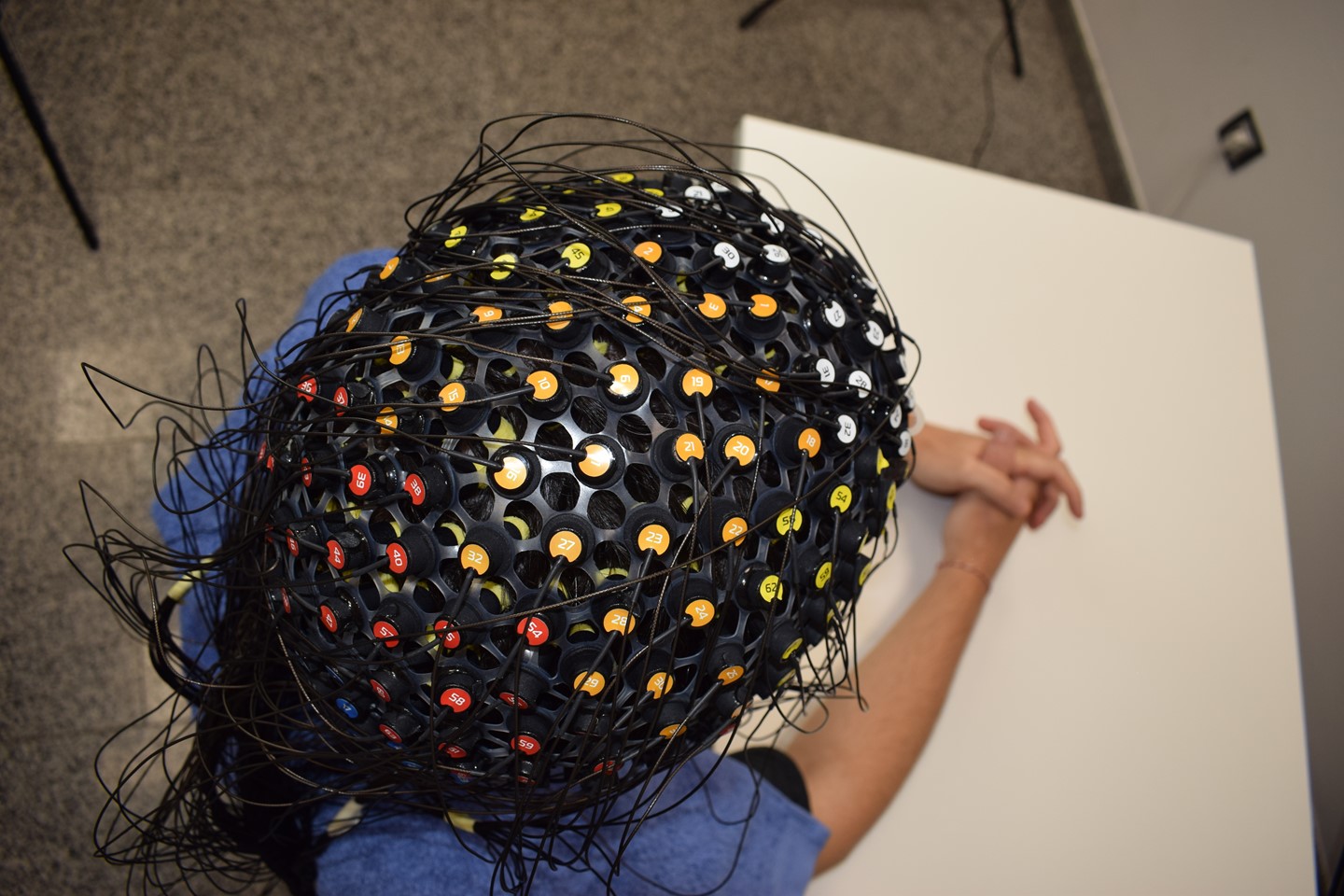
Furthermore, in preparation for this transition, a neuromodulation monitoring system for humans has already been developed (with the support of the team led by Luis Montesano at Bitbrain Technologies) and validated in patients with Parkinson’s disease (in collaboration with the team led by Maricruz Rodriguez at the University of Navarra Clinic). This system is based on high-density electroencephalography — a sensor-enabled cap that can be fitted and calibrated in under five minutes — allowing real-time detection and monitoring of deep neuronal activity.
Neumonas Project
Neumonas is a Pre-Commercial Public Procurement initiative for the development of R&D services in the field of non-invasive neuromodulation technologies. It is funded by the European Union (NextGenerationEU), the Spanish Ministry of Science, Innovation and Universities, the Centre for the Development of Industrial Technology (CDTI), and co-financed by the Recovery and Resilience Facility (RRF).
The project has been carried out in collaboration with TECNALIA and the following organisations: ACHUCARRO BASQUE CENTER FOR NEUROSCIENCE FUNDAZIOA, DONOSTIA INTERNATIONAL PHYSICS CENTER FOUNDATION (DIPC), Bit&Brain Technologies; University of Navarra – Clínica Universidad de Navarra (CUN); BIOFISIKA BIZKAIA FOUNDATION (FBB); Centre for Materials Physics (CFM-MPC, a joint CSIC-UPV/EHU centre); and UPV/EHU (University of the Basque Country – Euskal Herriko Unibertsitatea). The developments within the Neumonas project build upon, among other sources, prior knowledge generated within the Basque Nanoneuro Network (B3N) initiative under the IKUR strategy, as a Strategic Research Project within the Basque Country Strategic Investment Plan 2022–2024, supported and funded by the Basque Government’s Department of Science, Universities and Innovation.